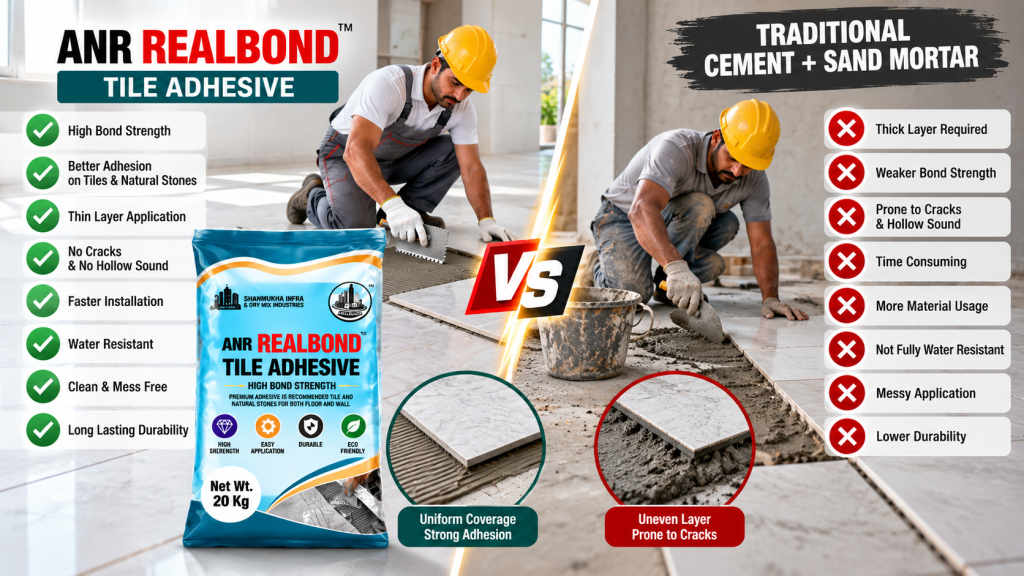
| Purpose | Specifically formulated for tile installation | Conventional cement-based fixing method |
| Composition | Cementitious adhesive with performance additives, depending on grade | Cement + sand + water |
| Application Thickness | Generally thinner and controlled | Generally thicker |
| Bonding | Formulated specifically for tile bonding | Conventional cementitious bond |
| Tile Types | Different grades available for ceramic, vitrified, porcelain, natural stone, etc. | More dependent on traditional installation method |
| Material Preparation | Dry product + specified water | Cement + sand + water must be proportioned |
| Consistency | Factory-controlled | Depends on site mixing |
| Workability | Designed for convenient application | Requires conventional mortar preparation |
| Tile Alignment | Controlled application helps achieve uniform installation | Thickness variation can affect alignment |
| Large-Format Tiles | Suitable when recommended by selected adhesive grade | Requires appropriate installation technique |
| Wall Application | Suitable grades may provide improved adhesion/slip resistance | Depends strongly on mortar consistency and workmanship |
| Wet Areas | Specific grades are available for suitable wet-area applications | Performance depends on mix and installation |
| Construction Speed | Generally faster and cleaner | Generally more labour-intensive |
| Material Handling | Easier storage and handling | Requires cement and sand storage |
| Best Application | Professional tile installation using the correct grade | Conventional applications where appropriate |